Engagement score
Every profile found in your database will not behave in the same way regarding your business activity.
- Some will show a lot of reactivity to your email communications: they will frequently open your emails and interact with them. Some will only react to your communications occasionally. Some others might hardly be active at all: their last email opening might be several months ago.
- Some of these contacts will gladly answer to your satisfaction surveys, while some other will not even consider filling in a form.
- Other contacts will not show interest to your email communications, but contacting them by SMS messages will be enough to convince them of interacting with your brand.
- Finally, the interest of some profiles for your brand will be expressed by repeated visits on your web site, or by orders on your e-commerce site. Both data can be tracked by goals.
All these parameters convey the engagement of your profiles with your business activity, through the many channels offered by Actito.
Engagement recency fields
In order to customize your communications with your profiles, it may prove relevant to consider the activity of each profile for each channel when you plan your campaigns. For example, if you decide to contact some profiles by emails and others by SMS messages, or if you wish to collect feedback through a survey.
Actito gives you the necessary tools to do so thanks to the profile engagement recency fields.
These fields are technical attributes which cannot be modified directly but are automatically calculated and updated by Actito. They are displayed on each single profile file, which can be accessed via the 'Profiles' app ( Apps > Profiles > Profiles , or via the sidebar).

In a profile file, in the 'Attributes' tab, the recency fields will be displayed under the 'Technical data' section, which is located at the bottom of the page.

The recency fields related to the various communication channels of Actito are as follows:
- Email target recency: gives the date and time when the profile has been last targeted by an email campaign
- Email opening recency: gives the date and time when the profile last opened an email
- Email click recency: gives the date and time when the profile has last clicked in an email
Only the first opening and the first click on each link are recorded.
The opening recency is therefore the first time a profile opened their last opened email.
The click recency is the first time a profile clicked on their last clicked link. If they click again on the same link later, the click recency is not updated.
- Mobile target recency: gives the date and time when the profile has last been targeted by an SMS campaign
- Mobile delivered recency: gives the date and time when the profile has last received an SMS message
- Mobile click recency: gives the date and time when the profile has last clicked in an SMS message with a short URL Actito
- Goal reach recency: gives the date and time when the profile has last reached a goal (website visit goal or transaction goal)
- Participation recency: gives the date and time when the profile has last filled in a form (partial or complete participation)
- Push target recency: gives the date and time when the profile has last been targeted by a push campaign
- Push delivery recency: gives the date and time when the profile has last received a push notification
- Push click recency: gives the date and time when the profile has last clicked in a push notification
- Push opening recency: gives the date and time when the profile has last opened a push notification
- WhatsApp click recency: gives the date and time when the profile has last clicked a WhatsApp campaign
- WhatsApp opening recency: gives the date and time when the profile has last opened a WhatsApp campaign
- WhatsApp target recency: gives the date and time when the profile has last been targeted by a WhatsApp campaign
Engagement recency
The last engagement recency field is a special case. It is named "Engagement recency".

Its value is equal to the value of the most recent recency field, whatever may be the communication channel:
- Email opening
- Email click
- Mobile delivered
- Mobile click
- Goal reached
- Form participation
- Push delivered
- Push click
- Push opening
- WhatsApp click
- WhatsApp opening
Both targeting recency fields (email and SMS) are not included in the calculation of the engagement recency, because merely being targeted does not necessarily mean that a profile is engaged with your brand.
While the activity level specific to each channel is useful to customize your communications, there are many cases for which it will be more relevant to consider the global engagement of your profiles and to know how recent is their digital activity with your brand, whatever may be the channel.
Instead of having to combine standard recency fields in your targeting criteria to ensure a whole coverage of your activity, the Actito engagement recency highlights the latest interaction recorded by Actito between a profile and your brand, whatever may be the channel.
This global field is used to calculate the Actito engagement score.
Engagement score

The engagement score is a visual indicator which allows you to check at first glance how engaged with your brand is a profile. This number alone will allow you to distinguish between very engaged profiles, to offer them a rewarding program, and profiles should rather be targeted with a reactivation campaign.
It is based on the Actito engagement recency field, which combines every other recency field available for each channel.
This is a decreasing score, for which the maximum of 100 means that the profile interacted with your marketing ecosystem on this very day (receiving an SMS, clicking in an email, reaching a goal, ...). The score will gradually decrease as the engagement recency date goes by, until reaching 0 when the latest interaction is longer than one year ago.
The Actito engagement score has 4 levels:
- Very good
- Good
- Fair
- Low
Every profile who has never been engaged with your activity will have a grey indicator and no value.
Engagement score as KPI
Actito calculates a global engagement index for each database, based on the engagement score of each individual profile. Just as the individual score, it goes from 0 to 100. This score is calculated by Actito for indication purposes: it might evolve over time.
This index will give you a global overview of the engagement of your data base as well as its evolution over three months. This is a key performance indicator displayed on the 'Dashboard'.
More than the current engagement level of your profiles, this indicator will allow you to measure the impact of your campaigns on this engagement, by measuring its evolution.

Industry benchmark
As index, the engagement score should be seen as a performance indicator related to your business sector.
The higher your engagement score, the better the interactivity of your database with your brand. However, unlike the individual engagement score of the profile file, the KPI is not displayed as a color scale.
Why?
Because comparing the score of your brand to the maximum of 100 is not helpful. We invite you to compare it to your own past performance (positive or negative trends) but also to your sector. Depending on your activity, this maximum score might remain an out-of-reach ideal. The engagement of your profiles will be indeed highly different if you are a media, for whom frequent communication is the core business, or if you operate online retailing and that your communications are a marketing tool above all else. The industry standards will inevitably have a high impact on the the behavior of your profiles towards the messages you send to them.
In order to let you interpret this score, we provide you with a benchmark which showcases the scores of each industry. You can therefore view your score as an indicator to compare with the various actors of your sector. To do so, Actito has gathered the data of 11 sectors in order to allow you to pinpoint yourself in relation to companies with an activity similar to yours. The following information stand at your disposal:
- The average score of the sector
- The lowest score of the sector (for the most populated database of a licence)
- The highest score of the sector (for the most populated database of a licence)
Thanks to the following table, you will be able to situate your engagement score in comparison to companies active in a sector similar to yours and therefore find out whether your digital activity is at the top of your sector or if improvements are necessary.
| Industry | Average | Maximum | Minimum |
|---|---|---|---|
| Education & Training | 89 | 93 | 84 |
| Media | 76 | 97 | 20 |
| Pharma | 75 | 91 | 67 |
| Services | 67 | 90 | 13 |
| Retail | 67 | 97 | 5 |
| Leisure | 66 | 93 | 43 |
| Banking & Insurance | 66 | 89 | 20 |
| Sporting Club | 65 | 89 | 36 |
| Energy | 61 | 81 | 41 |
| NGOs | 60 | 84 | 13 |
| Automotive | 51 | 68 | 36 |
Improving your engagement score
The engagement score provides as much information about the digital activity recency of your database as about your own marketing activity.
Indeed, just because a profile interacted once with your brand does not mean it is loyal to your brand. On the contrary, it is important to keep him engaged over time. This is why the engagement score is based on recency: a profile must remain engaged frequently to keep the maximum score.
This means that improving your engagement score can be directly influenced by your own marketing activity. This can be done by:
- Contacting your profiles with relevant email and SMS campaigns: more frequently and with customized content
- Collect feedback information by creating forms
- Set up goals to track website visits and transactions
Using the engagement score and the recency fields
Both the engagement score and the various recency fields are full-blown (technical) attributes of the profile file.
As such, in addition to being displayed in each individual file, they can be used:
In targeting
You can the engagement score and the recency fields as targeting criteria, to target profiles belonging to a specific engagement threshold or whom the recency (opening, click, participation,...) is equal to any time criteria relevant to your activity.
You will therefore be able to define a specific target according to the aim of your campaign, for example, whether it is a reactivation campaign or a campaign aimed at rewarding a strong digital activity.


In scenarios
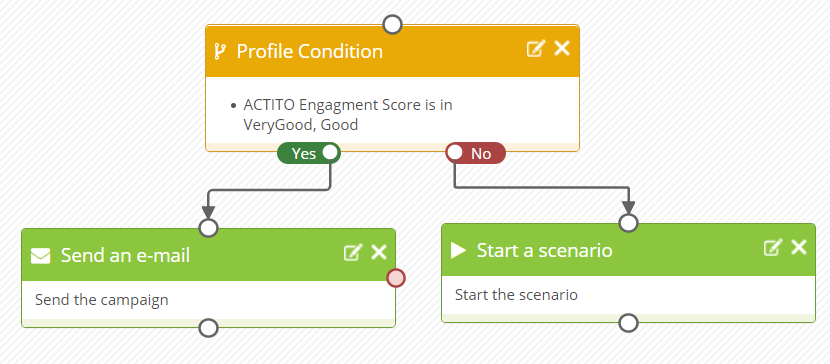
The engagement score and the recency fields can be used as filter to condition, in order to plan different actions according to the engagement of a profile and to automate these actions.
In segmentations
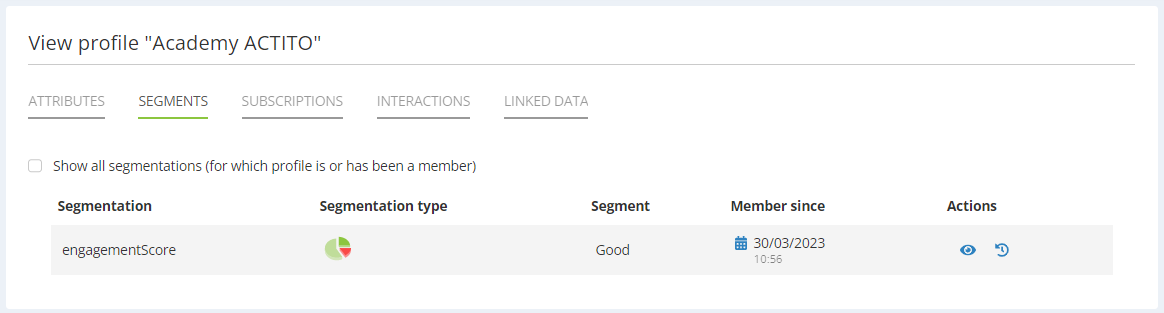
The engagement score and the recency fields can be especially relevant for defining segmentations based on the digital activity of a profile. For instance, an exclusive segmentation whose segments are based on the thresholds of the engagement score will enable you to apply this score to various Actito applications which make use of segmentations.
It can be used for:
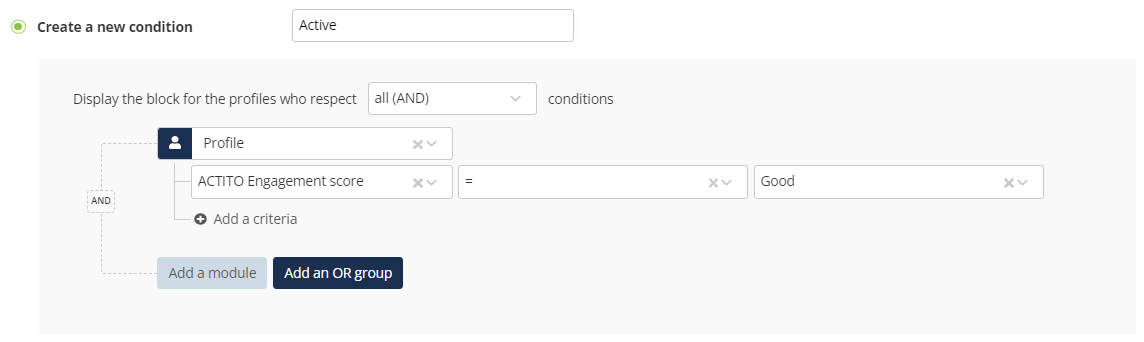
- Conditioning an email: it is possible to condition the blocks of an email according to a segment based on activity recency or engagement score. You will therefore be able to differentiate and customize the message of the same campaign depending on the activity of the targeted profile.
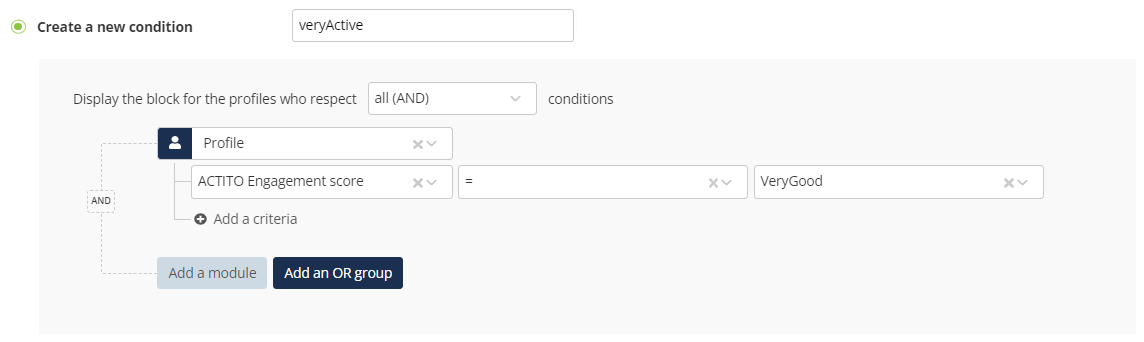
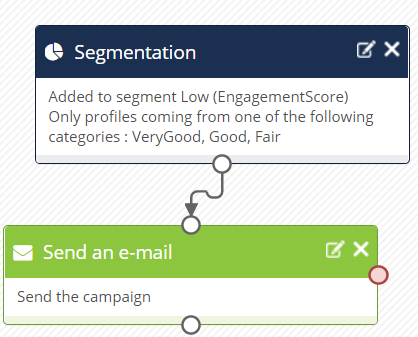
- Triggering a scenario: it is possible to trigger a scenario when a profiles is added to a specific segment (you can also define a criteria on its origin segment).
This will allow you, for instance, to automate a reactivation campaign when a profile who used to be engaged falls into 'Low' engagement score segment. As such, you will be able to send to send a message specifically dedicated to him in order to restore his interest, for instance by offering him to select the themes in which they are interested thanks to a Preference Center.
- Setting up a pre-filter segment: the engagement score or the recency fields are good criteria to create a simple segmentation used as 'Pre-filter segment'.
In data export
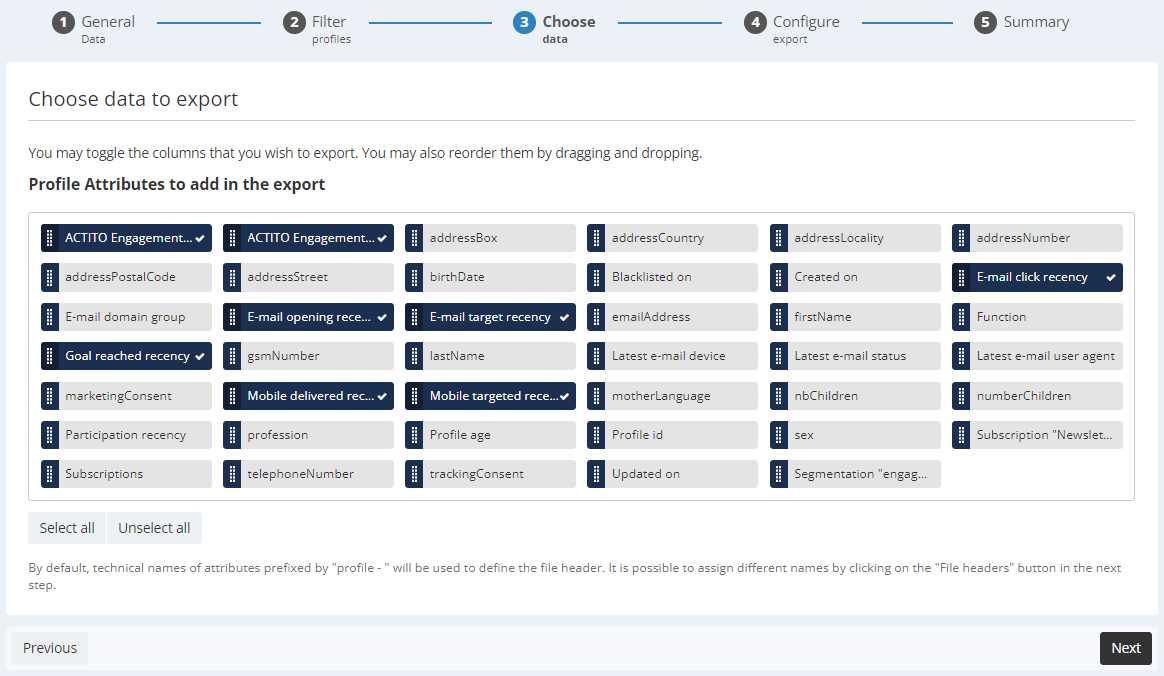
The recency fields and the engagement score are included in the data that can be used to complete a profile and custom profile export.
This allows you to associate the personal data of a profile with information related to its engagement with your brand.