RSS feed campaigns
Automate the distribution of your news and free up time for content creation by integrating RSS feeds into Actito.
Whether you want to publish daily articles or highlight new additions to your catalog, RSS feeds allow you to dynamically populate your emails (newsletters, alerts, scenarized campaigns) with fresh, up-to-date content, without the need for repetitive manual work.
They consist in producing, generally automatically, an XML file based on the updates of the content of a website. They take the form of a series of items, each corresponding to an article.
Actito allows to integrate RSS feeds thanks to different options:
- in the standard templates "RSS Newsletter" and "NewAlert"
- in specific blocks of the modules library
- in custom templates
It also allows you to update your campaign content based on the RSS feed by manually triggering the update in a mass campaign or by automating the update in a scenarized campaign.
Preparing your RSS feed
To ensure that Actito can read and process your RSS feed smoothly, certain standards must be followed.
Publication
An RSS feed is an XML file published at a public URL (without a password or access restrictions) so that Actito can extract its content.
Format
The RSS feed must follow the RSS XML 2.0 standard.
Within the RSS tags, the feed must contain items, which correspond to each article.
Within an item, the following tags can be used in Actito:
- title: the article's title
- enclosure: the URL of the image that will appear in the article
- description: the text associated to the article (for example, a brief introduction or the first line)
- link: the link to the other website where you can read the full article
- category: the article's category
- pubDate: the publication date of the article (to the format "Fri, 17 Jun 2022 15:30:00 +0200")
Although other tags are possible in RSS feeds (such as author, source, or tags specific to certain third-party tools), they cannot be used in Actito, and their content will not be retrieved. Only the 6 tags listed above are taken into account.
Order of display
Depending on the type of RSS feed integration (manual or automatic), the behavior differs:
- For manual integration, you can select any article.
- For automatic integration, Actito selects items based on their exact position in the feed, not on the pubDate parameter. The most recent articles must therefore be placed at the top of the feed.
Only the 99 most recent items of the RSS feed can be chosen.
Creating a compatible email with the RSS
To integrate an RSS feed in an e-mail, there are several possibilities:
1. Using a standard template
At the message creation step, choose the standard template "RSS Newsletter" or "NewAlert" in the Actito library.
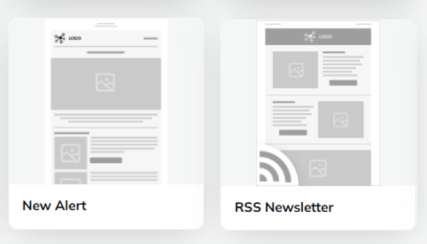
Most of the blocks in this template are configured to accept an RSS feed. You will recognize them thanks to the RSS icon at the top left of the concerned blocks.
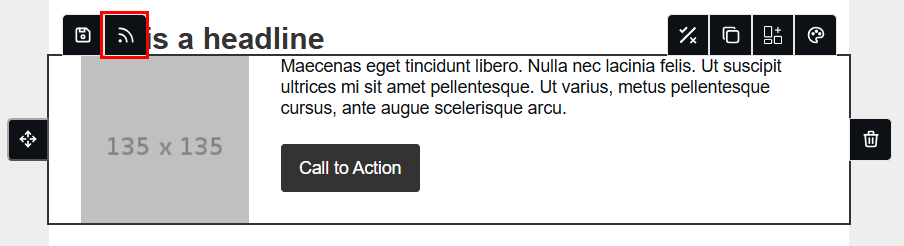
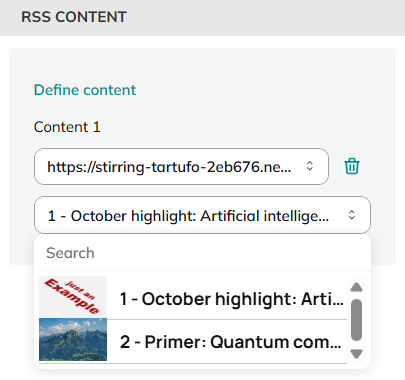
Click on this icon to manually insert a feed via a copy-paste of its URL and choose an article (or several for multi-column blocks) from your feed via the drop-down list.
2. Using the library of modules
If the design of your e-mail requires the use of another standard template, or if you already have configurations saved on another template, you can still insert RSS blocks thanks to the library of modules.

Go to the RSS category and choose the module design that suits you best. All modules in this category are compatible with RSS feeds.
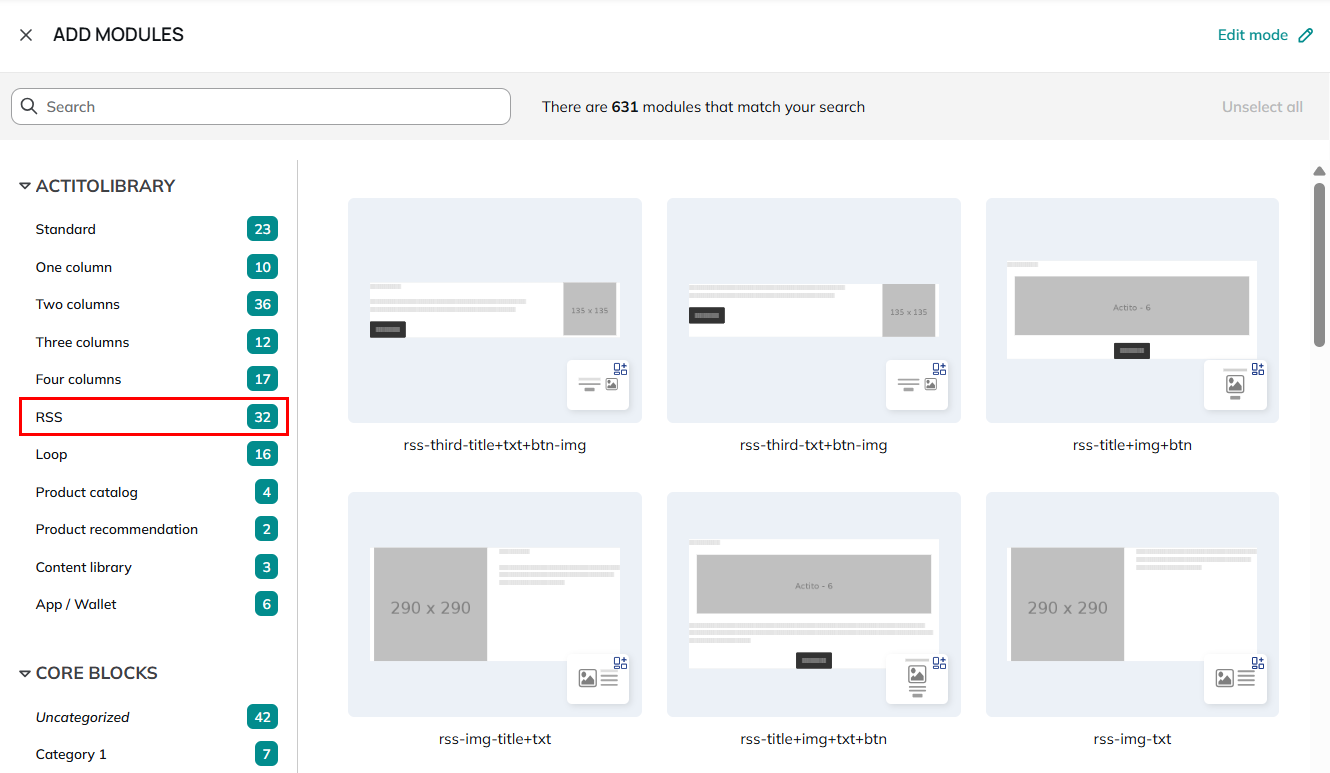
Once the block is added, you can set up the feed using the RSS icon at the top left of the block.
3. Using a custom template
When you order a custom template from Actito's team, you have the possibility to integrate RSS feeds directly.
This has several advantages:
- The right RSS feed is directly set on each block.
- Each article is directly linked to the right location in the block, without having to define it by hand (for example, in a block with several columns or locations, slot 1 will be linked to article 1, slot 2 to article 2, and so on).
This is particularly useful to facilitate automatic content filling.
For further information on customized templates, please contact your account manager.
Automating content fill by RSS
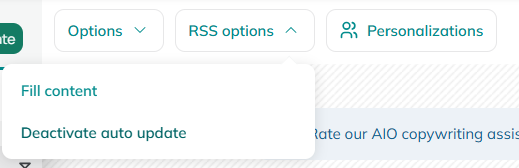
When a bloc with RSS feed is detected in a template, the RSS options menu appears at the top of the editor (between Options and Personalizations buttons).

In this menu, depending on the sending type of your campaign, one or two possibilities will appear :
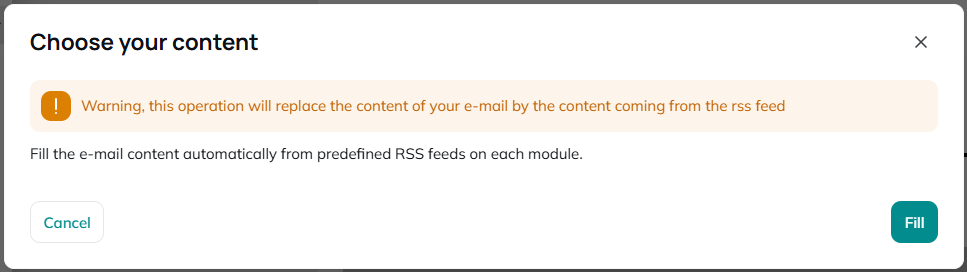
Filling the feed
This feature is available regardless of the campaign mode, but it is particularly well-suited for one-shot campaigns, which require periodic manual design and planning.

It allows you to automatically retrieve content from your RSS feeds to populate all associated blocks at once (images, text, and links will be updated based on the content published in the feed).
This action replaces and overwrites any manual changes previously entered in the affected blocks.
-
If your e-mail is based on the standard template RSS Newsletter or on a RSS module of the library, you have to define the feed in each block before you can fill the content at once.
-
If you use a custom template (or if you have saved your feeds in a campaign template), your feeds will already be preconfigured in each block, which will facilitate the use of content filling.
Activating the auto-update mode
This option is exclusively available for scenarized and transactional campaigns.
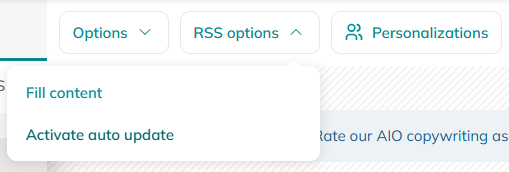
The auto-update allows you to update the content of your email when a modification is recorded on the associated RSS feed.
This way, each time the scenarized campaign is triggered for a profile, you can be sure that the email will contain the latest content added to the feed.
Creating an auto-update RSS campaign
To prepare an auto-update RSS campaign, you need to:
- Create a campaign in a scenarized (or transactional) sending mode
- Associate an RSS feed to the blocks that will be updated automatically
- Activate the auto-update in the RSS options
Once the automatic update is activated, the RSS AUTOUPDATE icon in the upper left corner of the page will indicate at a glance that this e-mail will be systematically fed by RSS.

The activation of the auto-update has the following effects:
- Manual editing disabled: Blocks associated with an RSS feed can no longer be edited manually for any RSS-compatible content fed by that RSS feed (such as images, text, and links) as it will be overwritten by the RSS content. Only the visual style remains editable.
- Dynamic updates: Once the campaign is activated, the content of RSS blocks will be periodically updated based on the latest changes to the feed.
RSS mapping only applies to the original block structure. Newly added columns and elements can't be linked to RSS content.
You should therefore be careful when using blocks with 3 or more columns as their layout adapts to the length of the titles and button text.
If one of your articles has a particularly long title or description, this could affect the layout and cause the length of the columns to no longer be aligned with each other.
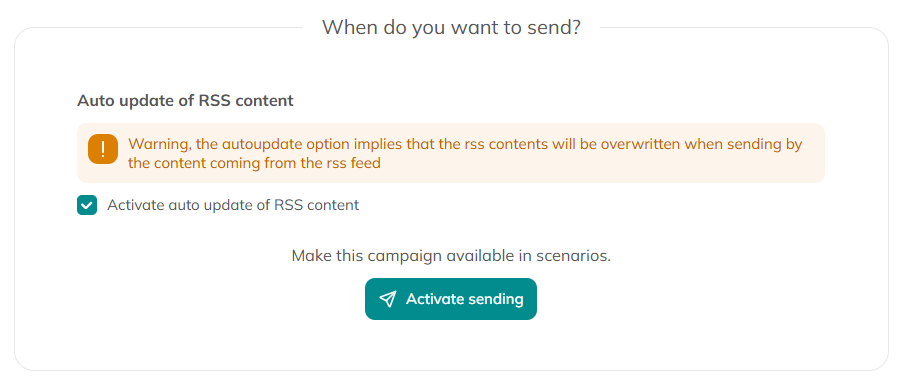
In the last step, when activating your sending, a warning reminds you that the automatic update of the RSS blocks is activated and that their content will be replaced depending on the RSS feed during the upload.
You can still disable this automatic update by unchecking the box before activating the sending.
Frequency of content update
The search for new content in the RSS feed is based on the principle of active waiting (or polling), which consists in checking every 5 minutes if the RSS feed has been updated. If a change is detected, the content of the email is updated based on the feed (always taking the first article in the feed first, in the order based on their position).
When you send a test email, the search for new content runs automatically, so your test email will always be sent with the latest content. The same applies to the activation of your email in the last step.
In practice, after an update of your RSS feed, the content will be updated in your e-mail within 5 minutes. If you have triggers or updates at a fixed time, it is therefore relevant to take this maximum delay into account.
RSS content in newsletters
You can also use an RSS feed to automatically populate the content of your template-based newsletters.
Blocks filled with RSS feeds will be updated each time the newsletter is generated. This allows your newsletters to include the latest articles or updates.
Errors in the RSS feed
For a smooth use of the automatic update by RSS feed, it is necessary that it is well formatted, that the chronology of the articles is reflected in their position and that the feed is well accessible. It is important that you ensure that your feed meets these needs.
If an error is detected :
- within an article (for example: syntax error, missing mandatory parameter): the article in error is ignored when updating, and the article from the previous version of the email is kept. As each location of a block is linked to a position in the RSS feed, it is important to note that the previous version of the content is kept, not the previous valid position in the feed. In a block with multiple columns, this means that a new article in error could cause both locations to display the same article. It is therefore important that the article has all the tags documented in the Format section.
- within the RSS feed (for example: the URL of the feed is inaccessible): the auto-update cannot be applied. The entire content of the email will therefore remain the same as the last valid version.
Modifying an auto-update RSS campaign
Once activated, an auto-update RSS campaign is visible in the tab of "in progress" campaigns and is prefixed with [ Auto-update ].
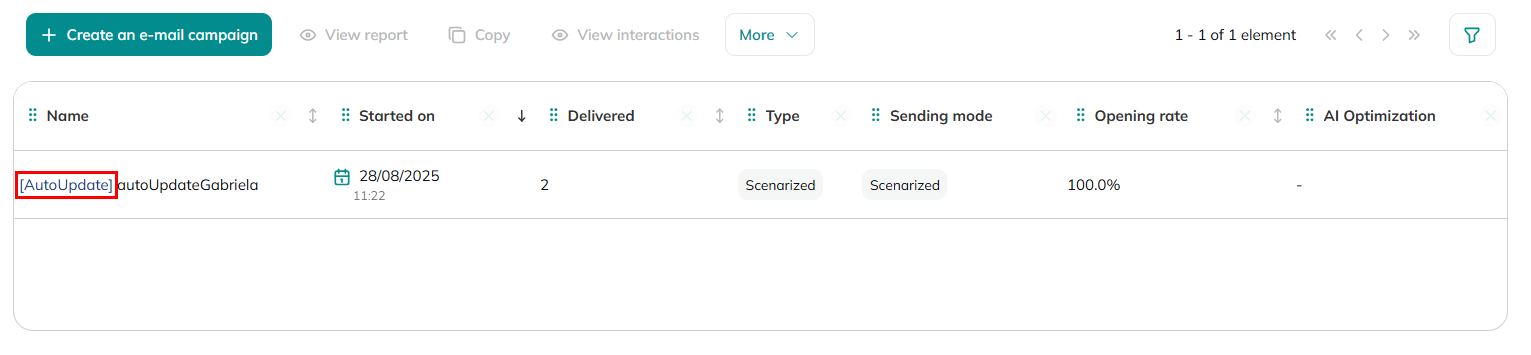
As is the case for all scenarized campaigns, you still have the possibility to correct them.
This allows you to modify content that isn’t updated via RSS, as well as edit the RSS feed linked to the campaign, change the blocks used to reference it, or disable automatic updates in the RSS options.
Content updated via RSS (titles, images, etc.) cannot be updated manually during editing, as it is automatically overwritten by the RSS content.
As for the classic scenarized campaigns, this campaign remains active as long as it is in correction and continues to be updated if a change is detected, triggering mailings with the most recent content.
Once correction is finalized, the system will immediately check for updates, and the content will therefore reference the latest version of the RSS feed (provided, of course, that the campaign is still in automatic RSS mode).
If you do not finalize the correction of the campaign at once, this campaign will remain available in the drafts with the prefixes [In correction] [Auto-update].
At the moment the correction starts but is not finalized, the prefix [In correction] also appears in the tap "In progress", where it remains active.

Seeing the report of an auto-update RSS campaign
By definition, an auto-update RSS campaign will be frequently updated and its content will change. This will affect the campaign's report, particularly in terms of clicks and preview views.
- Following the implementation of the auto-update RSS campaigns, the clicks won't be aggregated by name. Indeed, due to the frequently updated content, several different links can follow each other at the same location and thus share the same name, while being different. In the detail of the links, they will be separated on the basis of their URL (displayed on mouseover). However, the name is still available, notably in exports. This allows to use the name as a kind of "category" of the link in relation to its position in the campaign.
- In the preview, the latest version of the email will be displayed. On the other hand, the clicks displayed on the heatmap will not be linked only to this last displayed version. This visualization is therefore less relevant for an automatic RSS campaign.
Concerning the individual preview of a profile (at the level of its profile interactions, for example), it is also important to note that only the customizations are saved. The content itself is not saved at this stage, which means that the preview will not reflect the actual campaign received by the profile, but the latest version of the content.