Dynamic aggregates
Actito lets you build a targeting on dynamically aggregated data — that is, without any pre-calculation: the aggregate is computed at the very moment the targeting is launched.
These functions are available in the modules linked to custom tables:
| Function | Label in Actito | Example |
|---|---|---|
| Count | Number of XXX (at least one) | All profiles who have made more than 2 purchases |
| Sum | Total of XXX (with at least one line) | All profiles who have purchased for more than €500 — Sum(totalPrice) ≥ €500 |
| Min | Minimum of XXX (with at least one line) | All profiles whose smallest purchase is €10 |
| Max | Maximum of XXX (with at least one line) | All profiles who have never made a purchase over €50 |
| Average | Average of XXX (with at least one line) | All profiles whose average basket exceeds €60 |
The Sum, Min, Max and Average functions are only available on non-unique fields of type integer (INTEGER) or real number (NUMERIC).
The Count function is also available in the Email (advanced criteria), Goals and Scenario modules, to count the number of interactions or executions.
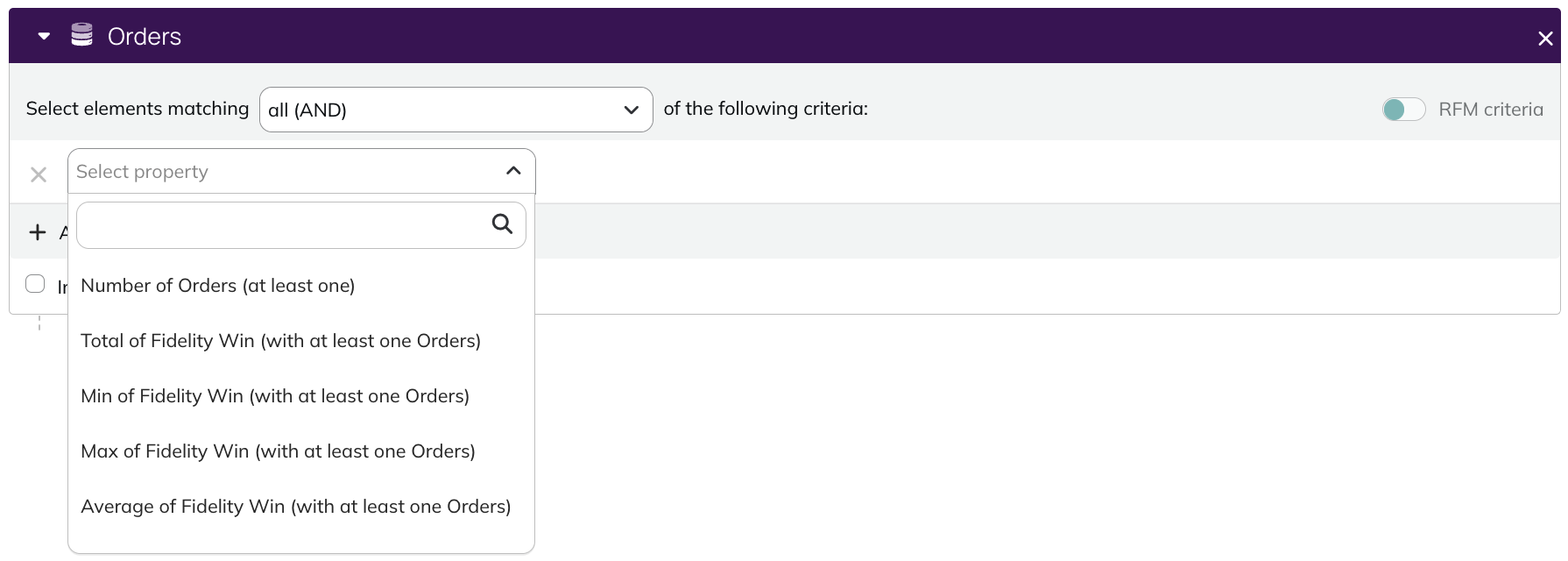
When a module is selected, only profiles that have at least one entry in the table can be retained. As a result, you cannot target profiles with no purchase by writing "Number of purchases = 0" (a profile needs at least one purchase to exist in the table): use the invert selection feature instead.
The available operators are:
| Operator | What it does |
|---|---|
| = | Searches for the strictly equal value |
| < | Searches for value(s) lower than |
| <= | Searches for value(s) lower than or equal to |
| > | Searches for value(s) greater than |
| >= | Searches for value(s) greater than or equal to |
| [ ] | Searches for value(s) between the two entered values (both bounds included) |