Offer
The Offer pass turns your coupons, discounts, and promotional offers into a live, always-available pass in Apple Wallet and Google Wallet. Your customers carry your offer with them at all times — no app required, no printed coupon to lose.
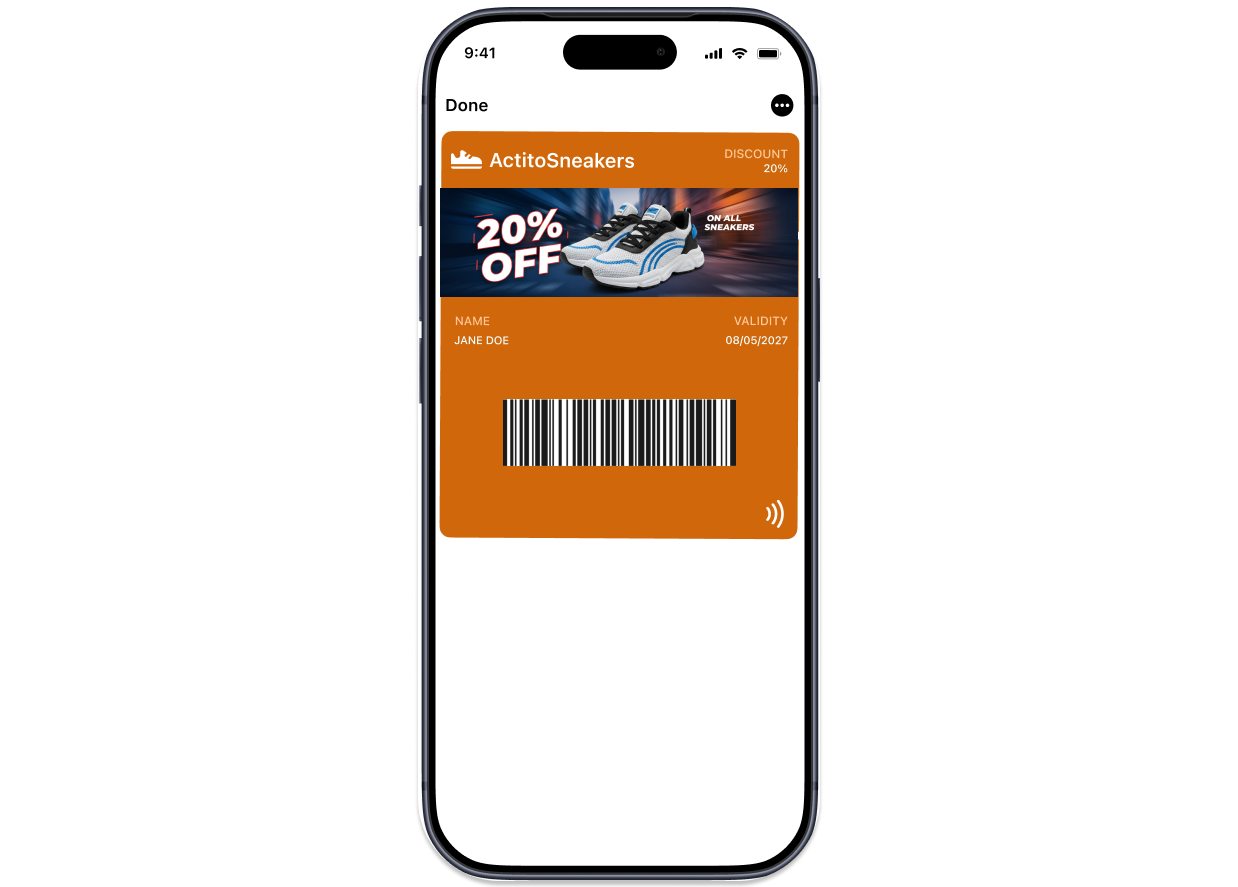
To create a new Offer pass template, go to the "Pass templates" module (Hub > Wallet > Pass templates).

Click on the Create a pass template button.
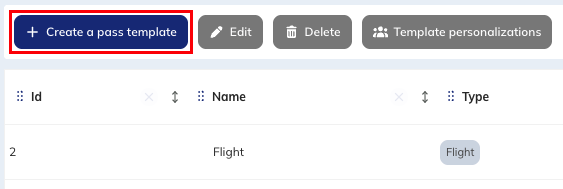
Once your template is created, you will need to define template personalizations from the Manage pass templates module.
One template must be created per offer type. If you run multiple promotions, create one template per promotion.
Step 1 - Setup
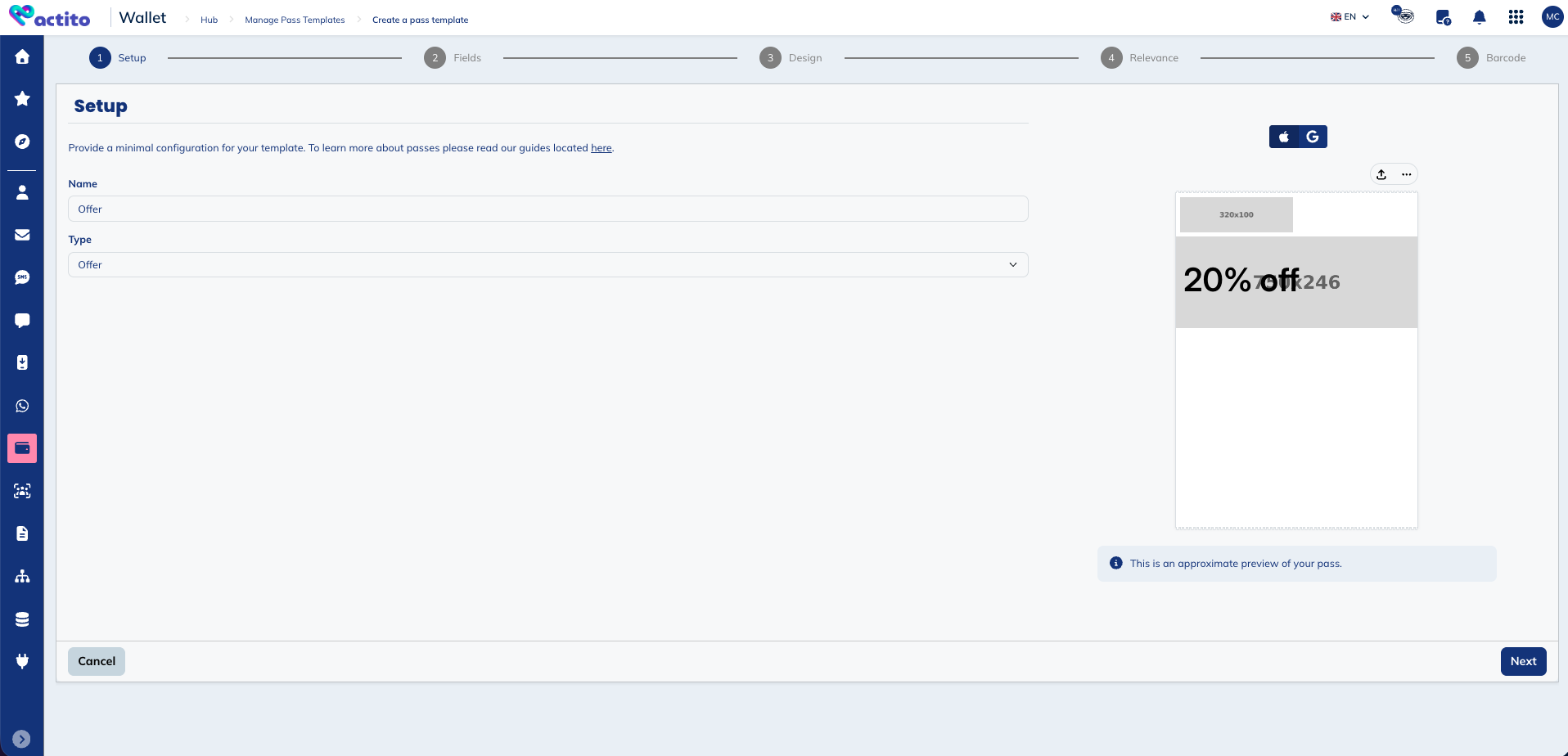
This first step enables you to define the basic information of your template:
- Name: the internal name of your template. This is only visible to you and your team in your licence. We recommend using a clear naming convention.
- Type: the type of your pass template. This determines the visual layout and available fields for this template.
Your template name is what appears in your pass list and reporting. If you plan to run multiple promotions simultaneously, include the offer name and period in the template name from the start.
Step 2 - Fields
Fields are the data that populate your passes. Every field you want to display or use, whether fixed or personalised, must be defined here first.
There are two types of fields:
- Common fields: the value is fixed and identical for all passes generated from this template. It cannot be changed at pass creation. Use these for offer-level data that is the same for every recipient: offer title, issuer name, background colour.
- Pass fields: the value can be overridden at pass creation. The value defined here is the default, used if no other value is provided. Use these for visual customisation that may vary per pass: colours, images.
You will have to add all fields you will be using in your pass template. These fields may then be included in your passes and ultimately define what data is displayed to users. In step 3, you will define where these fields will be displayed on the pass.
The fields that need to be personalised based on profile attributes will need to be configured in the template personalizations.
You may notice that some fields appear in both Common fields and Pass fields — for example, backgroundColor. This is intentional: Apple Wallet allows certain properties to be personalised at the individual pass level, meaning each issued pass can have its own value. Google Wallet, however, does not support this level of personalisation for those same properties and requires a single value shared across all passes. If you are issuing passes for both platforms, defining the field in both sections ensures maximum flexibility.
Common fields
Common fields define the offer-level data shared across all passes generated from this template.
Common fields are shared across all passes generated from this template. Their values can only be edited by updating the template directly. Note that changes to common fields will only apply to newly created passes. Existing passes can only be updated through an update campaign.
| Key | Type | Description |
|---|---|---|
issuerName | String | The name of the organisation issuing the pass (e.g. My Company). Displayed on the pass and used by screen readers. |
hexBackgroundColor | Color | The background colour of the pass in hexadecimal format (e.g. #FFFFFF). |
title | String | The main title of the offer displayed on the pass (e.g. 20% off). This is the primary value your customer sees. |
titleImage | Image | A square image representing the offer or brand. Size: 256×256 px. Use a PNG with a transparent background. |
wideTitleImage | Image | A wide banner image representing the offer. Size: 1032×336 px. Used on Google Wallet. |
Pass fields
Pass fields control the visual appearance of the pass for each individual issued pass.
Unlike common fields, these fields are reserved for any properties that contain unique details of a specific pass issued to a specific user. These fields may be changed whenever you create or update a specific pass.
| Key | Type | Description |
|---|---|---|
backgroundColor | Color | The background colour of the pass in hexadecimal format (e.g. #FFFFFF). |
foregroundColor | Color | The colour of the primary text on the pass (e.g. #000000). Ensure sufficient contrast with the background colour for legibility. |
labelColor | Color | The colour of the field labels (e.g. #000000). Labels are the small captions above each value. |
icon | Image | The app icon displayed in system notifications and the pass list. Size: 29×29 pt (@2x: 58×58 px). PNG with transparent background. |
logo | Image | Your logo displayed in the top-left corner of the pass. Size: 160×50 pt (@2x: 320×100 px). Transparent background is mandatory. |
strip | Image | A horizontal visual band displayed below the primary fields. Size: 375×123 pt (@2x: 750×246 px). Ideal for promotional visuals or brand patterns. |
heroImage | Image | A large decorative image displayed on the pass. Size: 1032×336 px. Use for brand visuals or offer imagery. |
Add and delete fields
You have the possibility to delete fields by ticking the box on the left side of the field and then clicking on Delete fields.

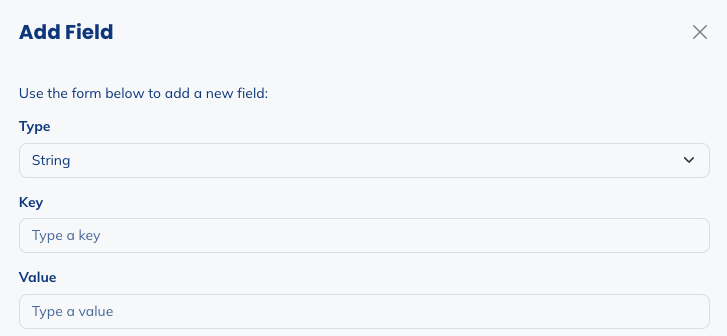
You also have the possibility to add fields if some are missing. Click on Add field.

For the added field, you will need to choose:
- the type: string, blob, date, number, money, color, image, JSON or boolean
- the key: the technical name of the field
- the value: the default value of the field
Step 3 - Design
Once all the fields you want to use in your template are added in the second step, you will have the possibility to define how your pass will be rendered on each platform. This step is split into two tabs, one for Apple Wallet and another for Google Wallet.
- Apple Wallet
- Google Wallet
Apple Wallet
The Apple Wallet tab is divided into four sub-tabs: General, Design, Data, and Semantics.
The Offer template looks like this:

General
In this tab, you can customize the basic information of your pass. For each field:
- You can choose common fields or pass fields you will have defined in the previous step. Only fields having the expected format will be available.
- You can add new field, if you forgot to add a field in the previous step, you can add it here and it will automatically be added to the list of fields from step 2.
- You can decide to use another value, a static value, that you are not planning on reusing in other fields.
In the following table, you'll find the fields and their description.
| Field | Description |
|---|---|
| Organisation name | The name displayed under your logo on the pass front. Typically your brand name. |
| Description | A short text description used by accessibility tools and device search. Example: 20% off your next purchase. |
| App Store Identifiers | Links your pass to an app in the App Store. A banner prompting the user to install your app appears on the back of the pass. |
| App's launch URL | An URL that opens your app directly when tapped from the pass. Requires an App Store Identifier. |
| User info | A metadata field for passing custom, non-displayed data alongside the pass. Useful for internal tracking or CRM linking. |
| Prevent pass sharing | When enabled, prevents the recipient from forwarding the pass. Recommended for single-use offers. |
Design
The Design sub-tab maps directly to the Pass Fields defined in the second step. Select the corresponding field for each visual element using the dropdown.
For the Offer pass, the available visual elements are: Logo text, Icon (29×29 pt, @2x: 58×58 px), Logo (160×50 pt, @2x: 320×100 px), Strip (375×123 pt, @2x: 750×246 px), Background color, Foreground color, and Label color.
On the right side of your screen, you have a preview of what your pass template looks like.
Data
The Data sub-tab lets you assign your fields to the visual zones of the pass (Header, Primary, Secondary, Auxiliary and Back). Use the Label, Key, and Value columns to control what is displayed in each zone and in what order.
For each zone of the pass:
-
You can add a field, where you will have to define different fields. Note that here, you define the design of the pass. Therefore, you will define the labels you want to show, and the value that should be displayed. These two are not necessarily from the same field you have defined in step 2.

- Key: the unique key for the combination of label and value
- Label: the label of the field, which is the part above
- Value: the value of the field, which is the part below
- Alignment: the alignment of the field
As you are defining the design of your pass template, you have the possibility to play with the different fields:
- Example 1: you could decide to put "OFFER" as the label, and the offer title as the value
- Example 2: you could decide to put the discount amount as the label, and the expiry date as the value.
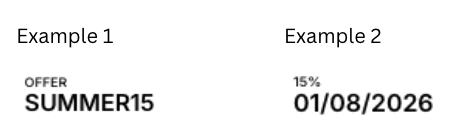
- You can delete a field from that zone of the pass, by ticking the box on the left side of the field and clicking on Delete field.
- You can edit a field by clicking on it.
The order of fields within each zone controls their left-to-right display order on the pass. Use the live preview on the right to check the layout as you configure it.
Semantics
Semantics are machine-readable metadata that Apple uses to power system-wide features such as Siri Suggestions, Spotlight Search, and proactive lock screen display. They are not visible on the pass itself — they work silently in the background to make your pass smarter.
For Offer passes, semantics are organised into two categories:
- Pricing — the value or discount amount associated with the offer: currency code and amount.
- Other — additional contextual data, including Wi-Fi Access (networks the pass can grant access to).
Filling in semantics is optional but recommended for offers where the discount value is central to the customer experience.
For each semantic:
- You can choose common fields or pass fields you will have defined in the previous step. Only fields having the expected format will be available.
- You can add new field, if you forgot to add a field in the previous step, you can add it here and it will automatically be added to the list of fields from step 2.
- You can decide to use another value, a static value, that you are not planning on reusing in other fields.
Google Wallet
The Google Wallet tab is divided into four sub-tabs: General, Design, Common Data, and Pass Data.
The Offer template looks like this:
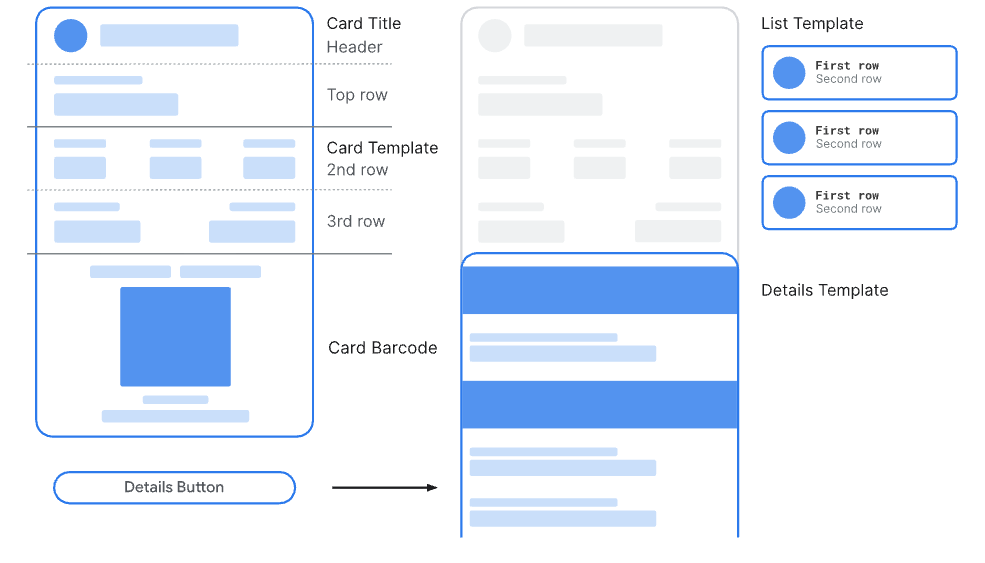
General
In this tab, you can customize the basic information of your pass. For each field:
- You can choose common fields or pass fields you will have defined in the previous step. Only fields having the expected format will be available.
- You can add new field, if you forgot to add a field in the previous step, you can add it here and it will automatically be added to the list of fields from step 2.
- You can decide to use another value, a static value, that you are not planning on reusing in other fields.
In the following table, you'll find the fields and their description.
| Field | Description |
|---|---|
| Enable smart tap | Activates NFC-based contactless redemption for terminals that support Google Smart Tap. |
| Security Animation | An animated security pattern displayed on the pass to prevent counterfeiting. Options vary by implementation. |
| Unlock Requirement | Defines whether the device must be unlocked to display or redeem the pass. |
| Multiple devices and holders allowed | Controls whether the pass can be saved by multiple users. Set to Single User for single-use offers. |
| Homepage URL | A URL displayed on the pass linking to your website or offer page. Maps to a Common Field value. |
| Screenshot Eligibility | Controls whether the pass can be screenshotted on the device. |
| NFC Constraint | Defines additional restrictions on NFC redemption behaviour. |
Design
The Design sub-tab maps directly to the Pass Fields defined in Step 2. For Google Wallet, only two visual elements are configurable: the Hero image (516×168 pt, uploaded at @2x: 1032×336 px) and the Background color. Select the corresponding Pass Field for each using the dropdown.
Common Data
The Common Data sub-tab maps your Common Fields to Google Wallet's structured offer data model, under the Generic Data section. Select the corresponding Common Field for each slot using the dropdown.
For each field:
- You can choose common fields you will have defined in the previous step. Only fields having the expected format will be available.
- You can add new field, if you forgot to add a field in the previous step, you can add it here and it will automatically be added to the list of fields from step 2.
- You can decide to use another value, a static value, that you are not planning on reusing in other fields.
Generic Data
| Field | Description |
|---|---|
| Issuer Name | The name of the organisation issuing the pass. Maps to issuerName. |
| Title Image | A square image representing the offer or brand. Maps to titleImage. Size: 256×256 px. |
| Wide Title Image | A wide banner image for the offer. Maps to wideTitleImage. Size: 1032×336 px. |
| Redemption Channel | Defines where the offer can be redeemed (e.g. Both, Online, In-store). |
| Provider | The name of the offer provider. Maps to issuerName by default. |
| Title | The main title of the offer. Maps to title. |
| Short Title | A shorter version of the offer title, used in compact views. |
| Details | Additional details about the offer (e.g. conditions, validity). |
| Fine print | Legal or regulatory fine print associated with the offer. |
| Help URL | A URL linking to a help page or offer terms. |
Pass Data
The Pass Data sub-tab defines data that can be customised for each individual pass.
For each field:
- You can choose pass fields you will have defined in the previous step. Only fields having the expected format will be available.
- You can add new field, if you forgot to add a field in the previous step, you can add it here and it will automatically be added to the list of fields from step 2.
- You can decide to use another value, a static value, that you are not planning on reusing in other fields.
App Links allows you to provide information about a companion app, across three sub-tabs — Android, iOS, and Web — each with the following fields: App logo image, App URL, Title, and Description.
Other allows you to enrich the back of the Google Wallet pass with additional content:
- Messages — contextual messages displayed to the pass holder.
- Images — additional images displayed on the pass.
- Info Texts — informational text blocks (e.g. terms and conditions, offer details).
- Links — external links displayed on the pass (e.g. to your offer page or app).
Always preview both the Apple Wallet and Google Wallet versions of your pass before publishing. The live preview on the right side of the screen updates in real time as you configure your design.
Step 4 - Relevance
Relevance defines when and where your pass surfaces automatically on the recipient's lock screen, without requiring a notification to be manually triggered.
For Offer passes, location-based relevance is one of the most powerful features available — surfacing a discount pass automatically when a customer walks past or enters your store is a proven driver of in-store conversion.
Locations
Add GPS coordinates to trigger the pass on the lock screen when the recipient enters a defined radius around a location. For Offer passes, the most relevant use cases are:
- Your store or point-of-sale locations
- Partner locations or event venues where the offer is valid
Apple and Google Wallet allow up to 10 locations per pass.
On Apple Wallet, Offer passes use a compact pass style, so this trigger typically activates within about 100 metres of the location — see Scope of location-based relevance for details.
Beacons (Apple Wallet only)
BTLE beacons allow ultra-precise, indoor triggering that GPS cannot achieve. If your stores have deployed Bluetooth beacons at entrances or checkout points, you can configure the pass to surface automatically when the customer's device detects a specific beacon.
Configure each beacon with its UUID, and optionally its Major and Minor values for more granular targeting.
Beacon-based relevance requires physical beacon hardware to be deployed on-site. Coordinate with your store operations team before configuring this option.
Step 5 - Barcode
The barcode is the scannable element that connects your digital offer to your in-store or online redemption infrastructure. See Choosing a barcode format for a comparison of formats and how to pick the one that matches your existing scanning infrastructure.
| Format | Description | Recommendation |
|---|---|---|
| None | No barcode displayed on the pass. | Only if your redemption is NFC-based exclusively. |
| QR Code | 2D matrix barcode. High data capacity, fast scanning, widely supported. | Recommended for most offer implementations. |
| PDF417 | 2D stacked barcode. | Use if your redemption system requires PDF417 specifically. |
| 1D (Code 128) | Linear barcode. Low data capacity. | Suitable for simple offer implementations with short codes. |
| Aztec | 2D matrix barcode. Compact and efficient, native to Apple Wallet. | Suitable if your scanning infrastructure supports it. |
QR Code is the most universally supported format for offer passes. If your existing redemption infrastructure uses a specific barcode format, match it here to ensure compatibility with your scanners and POS systems.